
On War, With an Orange.
By Jennifer Wang
December 3, 2025

Graphic by Samanvita Nalla
The ritual starts with small sniffles that creep in between days of spring break. Summer is near, and so is another wave of the flu. These elements create a lethal combination when paired with your spring allergies. You crave a remedy that might smooth the inflammation in your throat, so naturally you find yourself marching to the kitchen in search of relief.
At home, your grandmother keeps the fruit bowl stocked like a wall of nutritional defense. On the kitchen island, a mountain of oranges is piled high in the wooden bowl. They’re stacked in a pyramidal shape, uniform and waiting, beckoning you to inch closer.
You select your target with calculated care. The one you pluck from the bowl has a peel that’s thinner, smoother to the touch. It looks like it will give in to the destruction easier. Like the rest of the oranges, it’s perfectly round. You marvel at how perfectly it sits in your cupped palm.
It’s been ages since you’ve peeled an orange on your own. Growing up, your mother always did it for you. It was her way of showing love, shielding you from the small inconveniences of everyday life. But today, there is no one left to shoulder the burden for you.
You study the orange cradled in your hands, scanning for a place to start. The most logical point seems to be the base, where the skin caves in to create a small indent: a breach point. The fruit welcomes you to its ruination. You take it as an invitation.
Your freshly trimmed nails from yesterday become fragile tools turned weapons. They puncture the skin with ease. You twist your fingers inwards to sneak through the crevices between rind and flesh. It feels violent somehow.
This is necessary, you remind yourself. Not just for sustenance, but for proof that you still have control over some aspect of your body, even as the germs are waging a war with your immune system inside you.
And although you know it’s necessary, it still feels like you’re tearing a living creature apart. It feels like dismemberment. You wince every time you hear the peel rip. After a few tears, your fingertips start to ache from the strain.
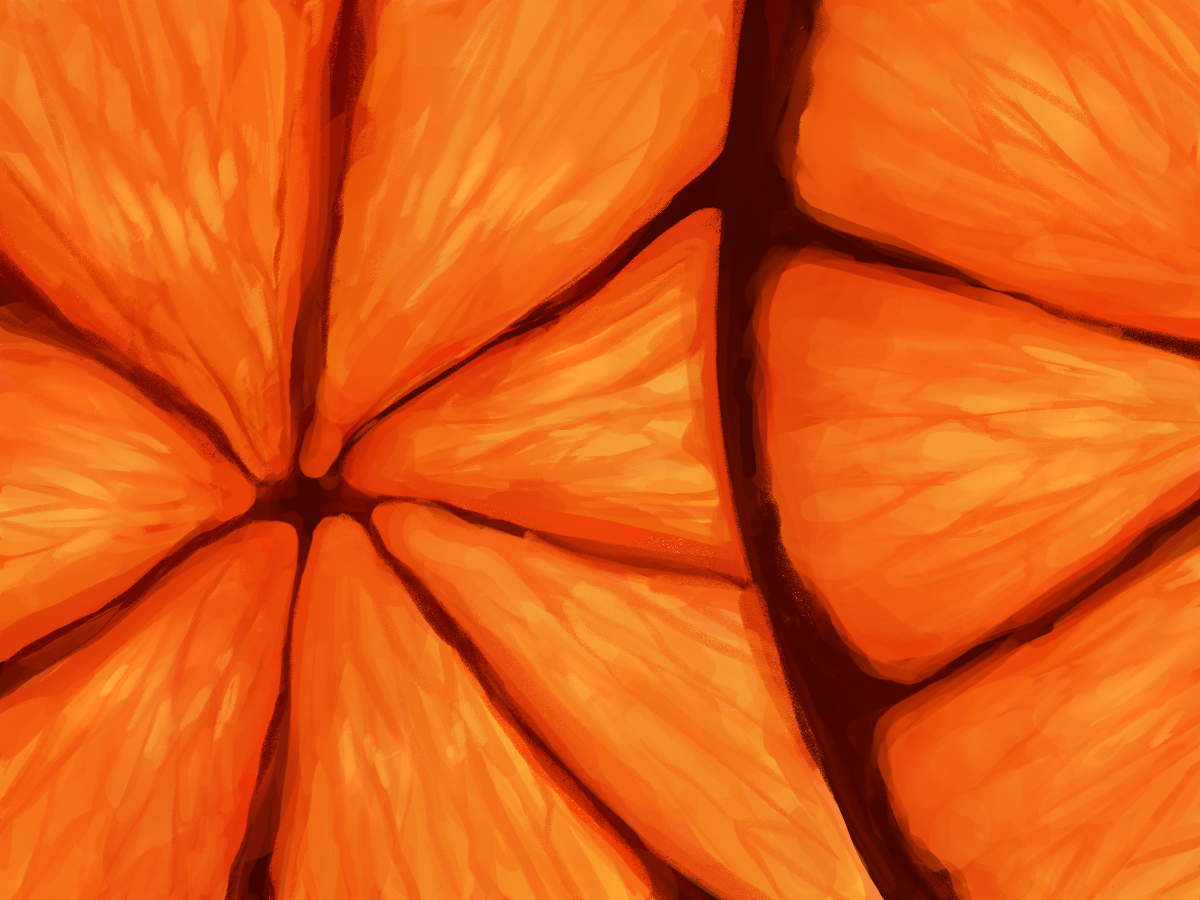
Graphic by Samanvita Nalla
When your mother peeled your oranges for you, the peel parted with ease. It always fell apart beautifully in six sections, as if it were a blossoming flower. Under your own hands, it resists. The peel refuses to come off clean. It’s shredded into sloppy chunks — some big, some small. Ragged shards of white rind are jammed into the space underneath your fingernails. There’s something gruesome in the act — something primitive, something visceral. You never realized how filthy violence could be, even in small doses.
Then again, the things you earn in life hardly ever come clean.
Rip, pry, toss and repeat. Just like that, you fall easily into this rhythm of violence, and the motions become more familiar with each tear. Just as you settle into the practice, your nails accidentally dig too deep into the membrane of the flesh. Your weapons struck too deep. A trail of juice slowly tickles its way down your arm.
As you break the last bits of the peel free, you’re left with a chunky sphere of an orange. Your uneven work is evident in the scars your nails inflicted on the white canvas that is the pith, like slashes across the skin of an animal, or a body. Your thumbs find their way to the core of the fruit, and they push inwards.
If the orange was the world, then your hands would be the war machine thoroughly wrecking it through.
You defy nature’s will to keep the orange whole, and brutally pry it into halves. Then again, into quarters. Then again, and again, and again, until the orange has been reduced to nothing but uneven slices.
The fruit sits mutilated before your very eyes. Its pulp glistens, bloodied and golden under the afternoon sunlight that seeps through the blinds. You sigh at the collateral damage as a pang rocks your chest. It’s the same feeling you get whenever you accidentally rip the wrapping paper of a beautifully packaged present—a swirl of shame, guilt, and irrational sadness that likes to linger inside of your ribcage.
It seems foolish to feel so strongly about the way you undress a fruit. You stare at the mess you’ve made—sticky and fragmented, crumbs in varying shades of orange dusting the wooden dining table, like ash strewn across a battlefield.
Your hands reach for a slice. As saccharine explodes on your taste buds, you wonder if the reward was worth the wreckage.
The last slice disappears between your lips before you notice. You wipe your hands on a towel, lick the dried remains of the juice from your wrists.
The orange is gone, but the ease with which we destroy, the justifications we like to defend ourselves with, and the rituals of violence we repeat in history remain.
You sweep what’s left of the orange’s exterior into a tissue paper. You clear the table of evidence on the casualty and dispose of it once and for all. A sweetness lingers in between the cracks of your teeth, but a bitter aftertaste haunts your tongue. The peel sits curled like a corpse in the trash bin.
Tomorrow, you will do it again. You will sit on the couch with your orange. The evening news will hum in the background, and a politician will echo the same sentiments you repeat like a mantra in your head as you tear your fruit apart.
We do this out of necessity. We do this for the greater good.
Then when you’re done, you’ll move to toss the remains in the trash, only to find yesterday’s peel browning at the edges.
You’ll hesitate for a split second before you lay the newer pieces on top.
Some rituals are catastrophic. But some are quiet, and come in the form of hands peeling fruit.
Violence, however small, becomes routine. ■
Other Stories in Voice
© 2025 SPARK. All Rights Reserved.