
Mythoplokos
By James Connolly
December 5, 2025


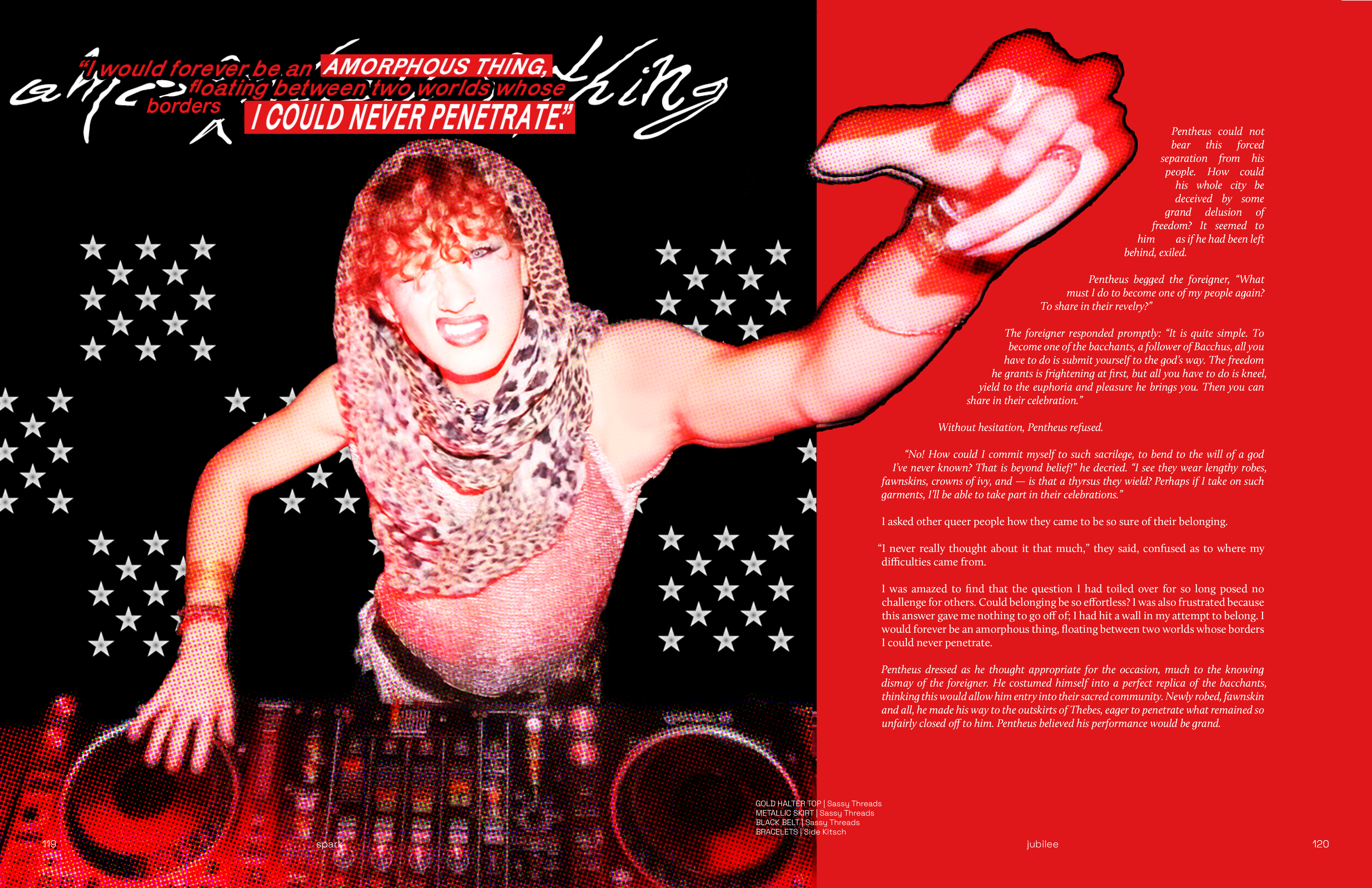

I felt always on the outside, trying to break in, trying to achieve the genuine connection I knew others had. Why did it seem that the only way for me to access community involved a falsified self-transformation?
A schizophrenic strobe cascades across the sea of skin, muscle, bone, and blood. Limb loosening substances flood the room. Supposedly, they loosen one’s soul, too. In this basement, made holy by the rituals performed within it, sweat-soaked figures undulate to a hypnotic rhythm. This is where those exiled from the outside world come to feel safe, to amalgamate into a mass minority.
They call this community.
Somewhere in this crowd, a body pretends to belong, a parasitic cell in an otherwise healthy organism. Somewhere in this body is me. Contrary to my expectations, here I have never felt more tightly wound, more individual, and more remote.
I’ve always had an issue with partying.
I detested the performative quality of becoming someone else for a night. Even more, I hated the substances I’d take to suppress the fact that this wasn't me, that this thing that everybody else loved was not something I loved. I forced myself into a mold of something I was not because it seemed that community came from partying for queer people my age. I craved that community. I envied the freedom of people who acquiesced so naturally, who simply belonged. I felt perpetually on the outside, trying to break in, trying to achieve the genuine connection I knew others had.
Why did it seem that the only way for me to access community involved a falsified self-transformation? When I couldn’t find answers myself, I did as I always had, and turned to literature.
Pentheus returned from abroad to find his native city overtaken by mass mania. The skeptical King of Thebes heard whispers of the city’s crazed citizens from afar, but did not heed such whispers until, upon reaching his homeland, he saw they were more than rumors. Indeed, the masses were given over to madness; they donned fawnskins, wreaths of ivy, and acted with an unfamiliar religiosity. They feasted on livestock with their bare hands and plundered villages. In a ritual site far beyond the city’s borders, they thumped the ground with decorated staffs and made wells of water, honey, and wine spring from the earth. They gorged themselves on these gifts and took to euphoric revelry.
“What has come over my people?" Pentheus thought.
His many questions would be answered when, walking the streets of the city, he came across a representative of the people, a foreigner who had come to Thebes in Pentheus’ absence.
The foreigner explained: “The people now kneel to Bacchus, the God of freedom, wine, and fertility. Bacchus grants the people a euphoria they have never known but which they have been searching for their entire lives. So great is this freedom, it nearly blinds them to the world that has, since their birth, tried to contain them. That is why your people now perform carnal and barbaric acts.”
I confided in a friend about the disconnect I felt with the queer community.
“I think you’re afraid of freedom,” he told me.
I was offended by this assertion. Freedom was all that I desired but could not achieve. I tried incessantly to make a genuine connection with the community I longed to be a part of. It was to no avail.
I thought maybe my approach was wrong. In trying to belong, I put forward an image of what I thought belonging looked like, as if that costume were the key to acceptance. But that costume — one of exaggerated flamboyance, frivolity, licentiousness — derived from a distorted and degrading perception of my community. For most of my life, I had been an observer, adopting a restrictive, normative perspective. And so, in an attempt to belong, I made myself fit a stereotypical mold that left me misshapen, ingenuine. Of course, I would feel out of place in that mold. To foster genuine connection, I needed to rework my approach.
Pentheus could not bear this forced separation from his people. How could his whole city be deceived by some grand delusion of freedom? It seemed to him as if he had been left behind, exiled.
Pentheus begged the foreigner, “What must I do to become one of my people again? To share in their revelry?”
The foreigner responded promptly: “It is quite simple. To become one of the bacchants, a follower of Bacchus, all you have to do is submit yourself to the god’s way. The freedom he grants is frightening at first, but all you have to do is kneel, yield to the euphoria and pleasure he brings you. Then you can share in their celebration.”
Without hesitation, Pentheus refused.
“No! How could I commit myself to such sacrilege, to bend to the will of a god I’ve never known? That is beyond belief!” he decried. “I see they wear lengthy robes, fawnskins, crowns of ivy, and — is that a thyrsus they wield? Perhaps if I take on such garments, I’ll be able to take part in their celebrations.”
I asked other queer people how they came to be so sure of their belonging.
“I never really thought about it that much,” they said, confused as to where my difficulties came from.
I was amazed to find that the question I had toiled over for so long posed no challenge for others. Could belonging be so effortless? I was also frustrated because this answer gave me nothing to go off of; I had hit a wall in my attempt to belong. I would forever be an amorphous thing, floating between two worlds whose borders I could never penetrate.
Pentheus dressed as he thought appropriate for the occasion, much to the knowing dismay of the foreigner. He costumed himself into a perfect replica of the bacchants, thinking this would allow him entry into their sacred community. Newly robed, fawnskin and all, he made his way to the outskirts of Thebes, eager to penetrate what remained so unfairly closed off to him. Pentheus believed his performance would be grand.
The foreigner knew his performance was not enough. “You might want to reconsider your method of acquiescing with the bacchants. Their freedom involved a more… spiritual change than costuming. They may not take kindly to this mere emulation.”
Pentheus cared little for the foreigner's advice.
“Spiritual change? Nonsense, I would never commit myself to such sacrilege," he said. “I know my people. I will be made one with them as soon as they lay eyes on me.”
Somewhere in my confusion, I reluctantly found myself going to another party. I knew it would be the same music, same lighting, same substances as always. I knew I’d relive my recurring unfulfilling experience. I knew I’d end the night feeling insecure and out of touch. So I didn’t dress up, nor did I get so fucked up that I would become another person. I simply showed up as I was, no costume imitating a flamboyance that wasn’t mine, no plan of action to be a part of some caricatured community.
Pompous Pentheus approached the ritual site without reservation and announced himself to the bacchants. “Look, my people! I have come to join in your manic praise of Bacchus, the god of freedom! See, I am dressed just like you, and like you wield a thyrsus; I have become one of you!”
The bacchants halted their celebrations and turned to their former king, unimpressed.
Having followed Pentheus along the way, the foreigner approached him and said, “I warned you, Pentheus, that your costume would not be enough, that the euphoria of freedom required mere spiritual submission. But you did not heed my warnings. Now I, Bacchus, must show you the consequences of your false submission!”
Bacchus set his followers upon the king of Thebes with a storm of wrath and rage. Before Pentheus could even cry out, they tore him limb from limb, severing with their bare hands bone, ligament, and viscera alike, rendering their former king an unrecognizable pile of gore. The final role Pentheus performed: a heap of flesh as unexciting as the convention he so desperately clung to.
I entered the party to a warm, inviting energy that I had never been privy to before. People were excited to have me there regardless of what I looked or acted like, what I consumed, or who I was with. This feeling was new to me, but my true revelation was that this feeling, this acceptance, had been available to me all along. I had just not seen it. Unbound by the restricting image of what I thought I should be, I no longer felt the need to perform. With no preconceptions about the party I was joining, I was able to get in touch with that genuine, euphoric relief that seemed beyond my reach for so long.
The same deafening, bass-heavy music played, the same blinding lights scattered across a crowd of people. Drinks went around a room of bodies that pulsed in unison to one rhythm, sharing a sacred moment. This time, though, there was no loneliness. I felt myself acquiesce. I felt myself, my truest self, belong. ■
Layout: Parker Ferguson
Photographer: Nicole Howard
Videographer: Rylie Shieh
Stylists: Zyla Alaniz, Elvia Garcia, & Taly Peralta
HMUA: Elena Durbin & Jalynn Shrepee
Models: Grecia Del Bosque, Tasmuna Omar, Amari Herrera, & Cameron Lightfoot
Other Stories in Jubilee
© 2025 SPARK. All Rights Reserved.