
NO ONE EVER LEAVES A STAR
By Olivia Ring
December 5, 2025


Your career in show business was buried, long forgotten — a murder covered up by the press. But you clung onto it, your state of grief forever paralyzed in denial — your greatest achievement. The Greatest Star of All.
“I AM BIG. IT’S THE PICTURES THAT GOT SMALL.”
INT. – 1950, A decaying Hollywood Mansion. 10086, Sunset Boulevard. One could ascertain that, in its prime, the house was incredibly glamorous. A lavish pool, two tennis courts, and terrazzo flooring that Valentino himself danced on. Now, it’s in decline, cobwebs flourishing on the rusting gold decor. (In a lot of ways, the house reflects its owner.)
You sit at your vanity, staring at yourself through a freshly cracked mirror. You can see your face through dozens of angles, but you’re focused on the center. You’ve applied enough makeup to mask at least 5 years of age, although makeup and beauty treatments can only do so much.
Next to you sits a framed photo of you in your prime: 22, attending the premiere of one of your films. You look at the photo, then back at yourself. You grab your blush, applying more and more, attempting to mold your face into how it looked thirty years prior.
Behind you, someone says, “Ms. Desmond, the cameras are ready for you.”
You stand up, solely focused on your performance — the way your face will appear on the screen.
You take a breath and then begin your descent down the stairs.
EXT. 1923, Paramount Studios, in its youth.
Your career grew alongside the golden age of Paramount Studios. You, a young, fresh face, headlined its days of silent film.
You had dreamt of a career in performance since you were young. You were bright-eyed and charismatic, discovered by a casting agent in a small cabaret. They told you your smile carried across the entire room. You had never felt more seen in your entire life. That pride stayed with you, the desire to entertain the masses, to feel seen by crowds of people.
Your face conveyed emotion that surpassed a need for words. Your performance carried countless films and iconic roles: Joan of Arc, Queen Elizabeth, Helen of Sparta. You were one of the most talented actresses of the silent era. Your repertoire only proved that.
News outlets described you as “The Greatest Star of All,” and in a way, you were. Your name alone was enough to guarantee a box office success. The biggest names in Hollywood swarmed you, showered you with praise, and you drank it all in. (This is what you were living for: the cameras, the audience, the glamor.)
Then the transition into talkies began. As an aging actress with little experience conveying emotion through dialogue, you were left behind from the artistic vogue. You were pushing 30 by that point. The studio executives decided that young, fresh faces should helm the transition away from silent film.
Your reputation as “The Greatest Star of All” waned as your fame dissipated and offers from studios grew sparse. The mailman stopped delivering fan mail. Your career in show business was buried, long forgotten — a murder covered up by the press. But you clung onto it, your state of grief forever paralyzed in denial. Your greatest achievement: The Greatest Star of All.
INT. 1949, that mansion on 10086, Sunset Boulevard.
You’ve been planning your return to the screen for years, but decades had passed, and your telephone was collecting dust. Your study is scattered with pages and pages of scripts for films that you’ll star in. You sit by your phone, waiting for the call from Paramount Studios, reading your stacks of fanmail. You ignore the similarities in handwriting, ignore that the postage comes from inside your own home. Delusion has seeped into every aspect of your life.
Your mental state is declining. You no longer feel secure, despite having all the money in the world. You buy a gun for protection, laying it upon your nightstand. You don’t plan on using it, but the security gives you comfort.
To relax, you watch your old films and fill your home with photos from the glory days. You put on “Joan of Arc,” your greatest achievement, and light up as the title displays on the screen. You would give anything to be on that soundstage again, cameras facing you, catching every expression you make.
At that moment, a car crashes into the garage. A young man, a disillusioned writer, steps out of the car. You could use a writer, and an interruption to the monotony of your life. Your scripts need a second pair of eyes before you ship them off to Cecil B. DeMille at Paramount.
Your offer is unbeatable: you would allow him to stay at your mansion on Sunset and provide him a guaranteed writing gig. No wonder he accepts it.
Beyond the fresh pair of eyes on your script, he provides you with companionship. You feel connected to him. He seems to be just as invested in your return to the screen as you are, and that’s what you need. You need someone to recognize your talent again, for people to see your face the way they once did. You feel like he might — maybe he does.
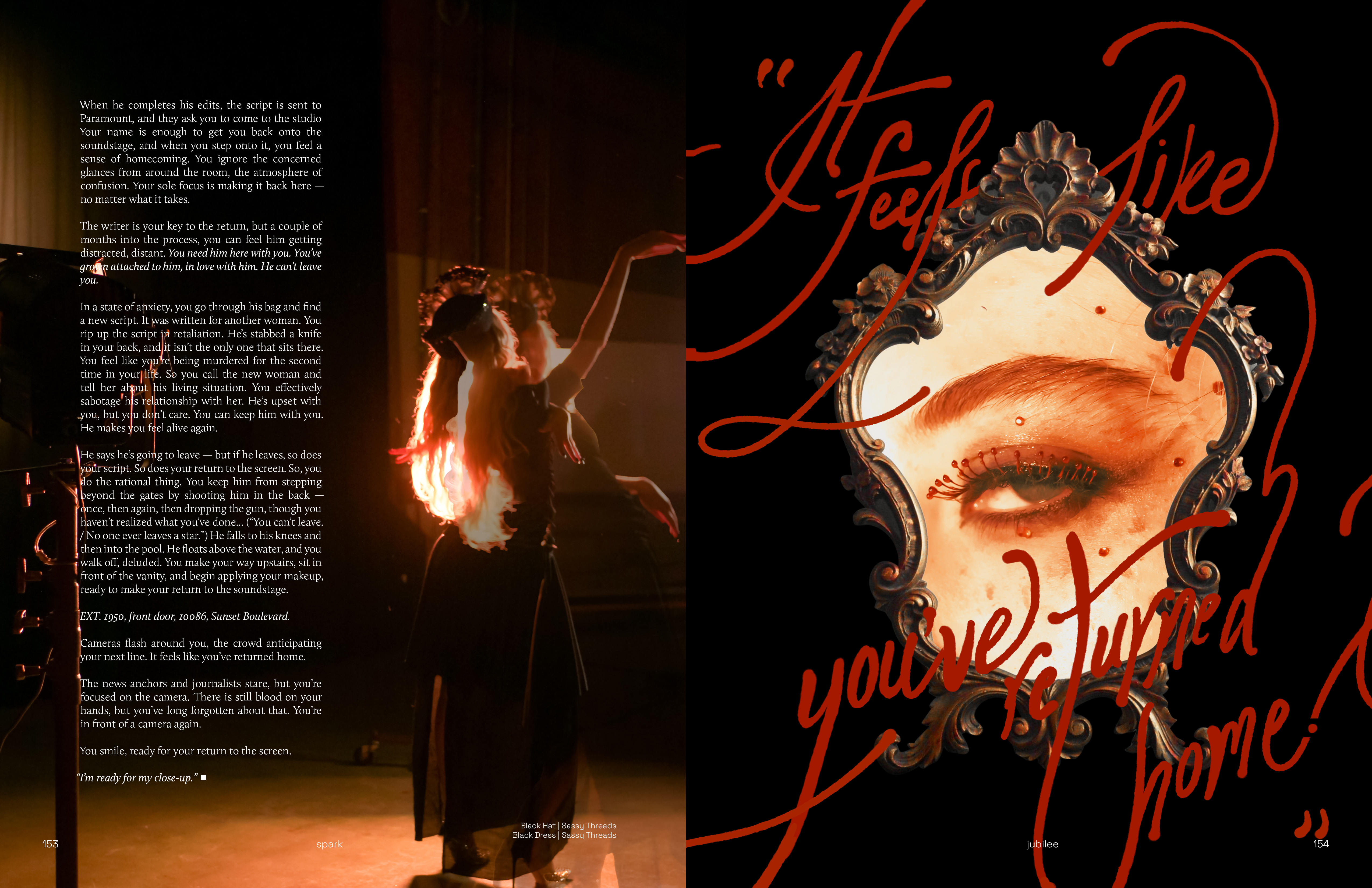
When he completes his edits, the script is sent to Paramount, and they ask you to come to the studio. Your name is enough to get you back onto the soundstage, and when you step onto it, you feel a sense of homecoming. You ignore the concerned glances from around the room, the atmosphere of confusion. Your sole focus is making it back here — no matter what it takes.
The writer is your key to the return, but a couple of months into the process, you can feel him getting distracted, distant. (You need him here with you. You’ve grown attached to him, in love with him. He can’t leave you.)
In a state of anxiety, you go through his bag and find a new script. It was written for another woman. You rip up the script in retaliation. He’s stabbed a knife in your back, and it isn’t the only one that sits there. You feel like you’re being murdered for the second time in your life. So, you call her and tell her about his living situation. You effectively sabotage his relationship with her. He’s upset with you, but you don’t care. You can keep him with you. He makes you feel alive again.
He says he’s going to leave — but if he leaves, so does your script. So does your return to the screen. So, you do the rational thing. You keep him from stepping beyond the gates by shooting him in the back — once, then again, then dropping the gun, though you haven’t realized what you’ve done... (“You can’t leave. / No one ever leaves a star.”). He falls to his knees and then falls into the pool. He floats above the water, and you walk off, deluded. You make your way upstairs, sit in front of the vanity, and begin applying your makeup, ready to make your return to the soundstage.
EXT. 1950, front door, 10086, Sunset Boulevard.
Cameras flash around you, the crowd anticipating your next line. It feels like you’ve returned home.
The news anchors and journalists stare, but you’re focused on the camera. There is still blood on your hands, but you’ve long forgotten about that. You’re in front of a camera again.
You smile, ready for your return to the screen.
“I’m ready for my close-up.” ■
Layout: Amyan Tran
Photographer: Julianna Stennett
Videographers: Clay Keener & Sienna Madrigal
Stylists: Dani Goodlett & Aidan Vu
HMUA: Janhavi Lalwani
Nails: Hailey Chuong
Model: Victoria Nicolaevna
Other Stories in Jubilee
© 2025 SPARK. All Rights Reserved.