
Original Sin
By Ari Smith
December 5, 2025

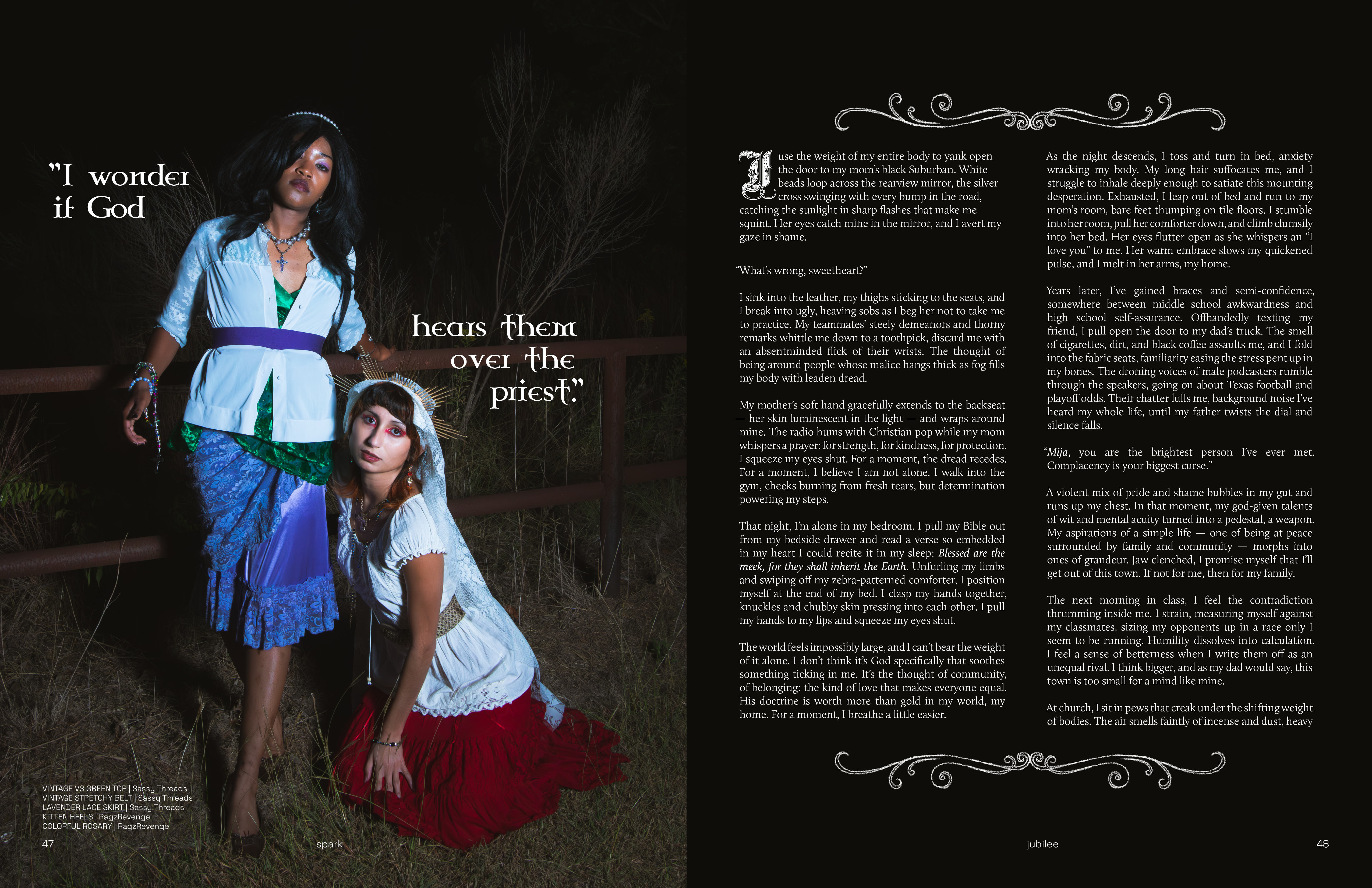

I pray in two tongues
I use the weight of my entire body to yank open the door to my mom’s black suburban. White beads loop across the rearview mirror, the silver cross swinging with every bump in the road, catching the sunlight in sharp flashes that make me squint. Her eyes catch mine in the mirror, and I avert my gaze in shame.
“What’s wrong, sweetheart?”
I sink into the leather, my thighs sticking to the seats, and I break into ugly, heaving sobs as I beg her not to take me to practice. My teammates’ steely demeanors and thorny remarks whittle me down to a toothpick, discarded with an absentminded flick of their wrists; the thought of being around people whose malice hangs thick as fog fills my body with leaden dread.
My mother’s soft hand gracefully extends to the backseat — her skin luminescent in the light — and wraps around mine. The radio hums with Christian pop while my mom whispers a prayer: for strength, for kindness, for protection. I squeeze my eyes shut. For a moment, the dread recedes. For a moment, I believe I am not alone. I walk into the gym, cheeks burning from fresh tears, but determination powering my steps.
That night, I’m alone in my bedroom. I pull my Bible out from my bedside drawer and read a verse so embedded in my heart I could recite it in my sleep: Blessed are the meek, for they shall inherit the Earth. Unfurling my limbs and swiping off my zebra-patterned comforter, I position myself at the end of my bed. I clasp my hands together, knuckles and chubby skin pressing into each other. I pull my hands to my lips and squeeze my eyes shut.
The world feels impossibly large, and I can’t bear the weight of it alone. I don’t think it’s God specifically that soothes something ticking in me. It’s the thought of community, of belonging: the kind of love that makes everyone equal. His doctrine is worth more than gold in my world, my home. For a moment, I breathe a little easier.
As the night descends, I toss and turn in bed, anxiety wracking my body. My long hair suffocates me, and I struggle to inhale deep enough to satiate this mounting desperation. Exhausted, I leap out of bed and run to my mom’s room, bare feet thumping on tile floors. I stumble into her room, pull her comforter down, and climb clumsily into her bed. Her eyes flutter open as she whispers an “I love you” to me. Her warm embrace slows my quickened pulse, and I melt in her arms, my home.
Years later, I’ve gained braces and semi-confidence, somewhere between middle school awkwardness and high school self-assurance. Offhandedly texting my friend, I pull open the door to my dad’s truck. The smell of cigarettes, dirt, and black coffee assaults me, and I fold into the fabric seats, familiarity easing the stress pent up in my bones. The droning voices of male podcasters rumble through the speakers, going on about Texas football and playoff odds. Their chatter lulls me, background noise I’ve heard my whole life, until my father twists the dial and silence falls.
“Mija, you are the brightest person I’ve ever met. Complacency is your biggest curse.”
A violent mix of pride and shame bubbles in my gut and runs up my chest. In that moment, my god-given talents of wit and mental acuity turned into a pedestal, a weapon. My aspirations of a simple life — one of being at peace surrounded by family and community — morph into ones of grandeur. Jaw clenched, I promise myself that I’ll get out of this town. If not for me, then for my family.
The next morning in class, I feel the contradiction thrumming inside me. I strain, measuring myself against my classmates, sizing my opponents up in a race only I seem to be running. Humility dissolves into calculation. I feel a sense of betterness when I write them off as an unequal rival. I think bigger, and as my dad would say, this town is too small for a mind like mine.
At church, I sit in pews that creak under the shifting weight of bodies. The air smells faintly of incense and dust, heavy with silence except for the priest’s monotonous preaching. Sunlight filters through stained glass, bleeding color across the yellowed walls, but the beauty is lost on me as my knees ache from kneeling and my flesh screams to stand.
Beside me, older women whisper in quick Spanish about neighbors and grandchildren, their gossip rising and falling like waves against the priest’s steady drone. Their words dig into me, filling the sanctuary with sharp little secrets. Reprimands of mediocrity and laziness spill from their tongues, miles darker than the prayers they so reverently plead. I wonder how faith can exist alongside such judgment. I wonder if God hears them over the priest.
In that pew, I realized what I’d always known: there is no compromise between the God of my culture and the one of the world. Life along the southern border lives in that tension, caught between reverence and restlessness. Families are held together by prayers and carne asadas, by candles burned for those who left and for those who never could. I learned early that my worth is measured in service: how often I show up, who I feed, who I forgive. It’s a world that taught me to carry others before I ever learned how to stand on my own.
But the world beyond, the American world, runs on a different kind of devotion. It praises ambition like a virtue, competition like communion. The promise of progress hums through classrooms and cities and universities. I am only as good as my last achievement; I can always climb higher if I’m willing to leave something, or someone, behind. And so, I grew up fluent in both faiths: one that tells me to bow my head and another that demands I raise it. I learned to navigate both altars until I couldn’t tell which god I was serving.
When my father told me complacency was my biggest curse, I heard it as both blessing and burden. To him, success was proof that the sacrifices meant something, that the leaving was worth it. My mother’s arms, ever open and gracious, now smothered me. But I’ve always wondered if, in chasing that promise, I was trading the closeness of my people for the coldness of independence.
The God of my home, my mother, values quiet endurance, bowed heads, and full tables. The God of the world, my father, rewards hunger, the kind that empties my plate before anyone else has eaten. I have spent my life trying to feed both.
Now, I grip the steering wheel of my own car, my palms damp with sweat. The rosary swings from the rearview mirror, its beads clinking softly against the glass. I don’t pray anymore, but I can’t take it down. I drive past half-remembered towns — gas stations and faded storefronts, half-English signs and half-forgotten saints. As the miles peel away, I know what waits for me: the familiar buildings of my hometown, their facades worn and sun-faded, the same panaderías, taquerías, and gas stations that have always been there. Some new storefronts have sprouted up, awkwardly shiny against the old brick, but most things haven’t changed. That’s the thing about home: it resists.
My playlist hums through the speakers, songs that don’t carry sermons but still feel holy in their own way. I think about my mother’s prayers, my father’s grit, the way faith clings to us like humidity. Maybe the God of the world and the God of my home aren’t enemies but mirrors, both asking for devotion, both demanding sacrifice. Maybe the sin isn’t in choosing one, but in pretending I can serve them equally.
I don’t know if my hunger for more is ambition or inheritance, if my longing for home is strength or weakness. I don’t think I’ll ever know. I’ll spend forever in this antinomy, never quite reaching either heaven. The border doesn’t just divide nations — it divides gods. It cuts through me. ■
Layout: Erin Jeon & Andy Kang
Photographer: Meadow Riley
Videographer: Joseph Chunga Pizarro
Stylists: Emmeline Hurter & Sophia Marquez
HMUA: Nausheen Hossain
Models: Amari Herrera & Yasmin Champion-Evans
Other Stories in Jubilee
© 2025 SPARK. All Rights Reserved.