
Painting and other mysteries
By Anjali Krishna
December 5, 2025


“What good does all the research of the Impressionists do them / when they never got the right person to stand near the tree when the sun sank?”
– Frank O’Hara, Love Poems
In the moments before close, the gallery is quiet. Only the noise of air conditioning whirs on with the faint sound of footsteps being rushed outside. I have a few seconds left before the attendant will fetch me too, tell me politely that the museum is now closed. For a bit, though, I have what’s arguably the best seat in the house—a cold black leather lounger in front of Jackson Pollock’s “One.”
Seated upright, shoulders back, I tilt my head one way and then the other. I send my gaze right side up and upside down. I trace the shapes in the paint splatters and then try not to read into them at all. I’ve already moved up close, studied the layers of material and shine. These details are written carefully in my notebook. On the seat now, I’m trying a different approach, hoping distance can offer clarity on why the painting matters. So far, distance hasn’t offered too much at all. Ungenerous.
I underline in blue pen beside the listed names of Pollock’s paintings, need to understand and analyze. I add a few exclamation points for good measure and leave before anyone comes to get rid of me.
In the window seat of the F train, I tap my foot to the rhythm of badly-fixed potholes hopped up on sugary raspberry tea. I count the stations as they go by: eight stops between 57th St. and 2nd Ave. There’s a drum performance — on an upside down Home Depot bucket — that I can’t decide if I’m supposed to like between the gaps of Joni Mitchell in my headphones.
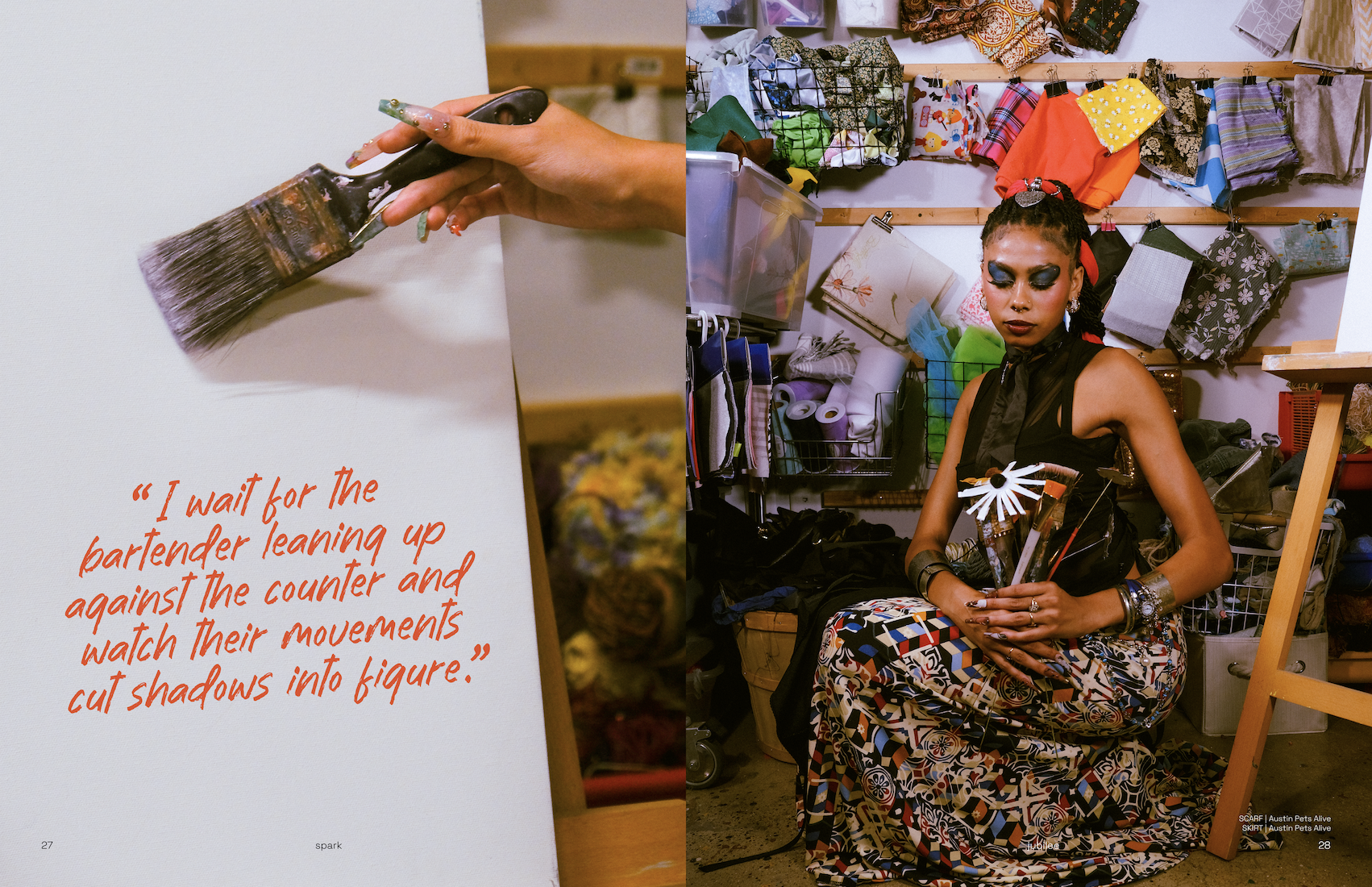
Low-lit, white-hot in the heady summer air, I find my friends tucked into the corner of Tile Bar. I wait for the bartender leaning up against the counter and watch their movements cut shadows into figure. As Reva gesticulates, Jay and Ashrith shake their heads and laugh. It’s Thursday — the night is warm, spirits high.
I want a drawing of the moment, an image. But when I raise my phone to take a picture, I catch Jay’s eye through the camera and we both begin to laugh.
When the bartender gets around to me, he asks if I want the double vodka sour my friends are having. These days, this is the sort of thing which makes me happy: personal recognition from perfect strangers and my friends at our usual table. I sketch a smile and order another round, watching the soft hiss of the soda gun fill our glasses.
Lately Reva and I have been spending our hungover Sundays at the park, and I’ve been reading Frank O’Hara: the pocked-sized version Rhys got me before I left for New York. I think it’s in “To You” that he wrote “there’s no need for vistas we are one / in the complicated foreground of space.” Reva reads Dolly Alderton in the grass beside me.
Before the summer, I thought I knew a lot of things. I could tell you about the types of Classical columns (Doric, Ionic, Corinthian) and how the Umayyads co-opted Byzantine imagery. I could write essays about the ethics of repatriating the Benin Bronzes or what it meant to see curatorial diversity in contemporary shows. I inhaled facts from dark slideshows and spit them out on exam papers with a Youthful Leftist tilt. In the margins of my papers, professors wrote things like “deep insight” and “good point!”
On weekends in my apartment, I read interviews with famous authors before their first books and long-form articles about the cobalt mining in the Congo. These are the sorts of things that interest me, I liked to think before shutting my computer to talk with my roommates in the living room. Even then, I found the two worlds hard to balance — the reality which glowed so valiantly, or some other thing, a third dimension almost secular from my life where I read academic papers and produced novel comments about art and literature.
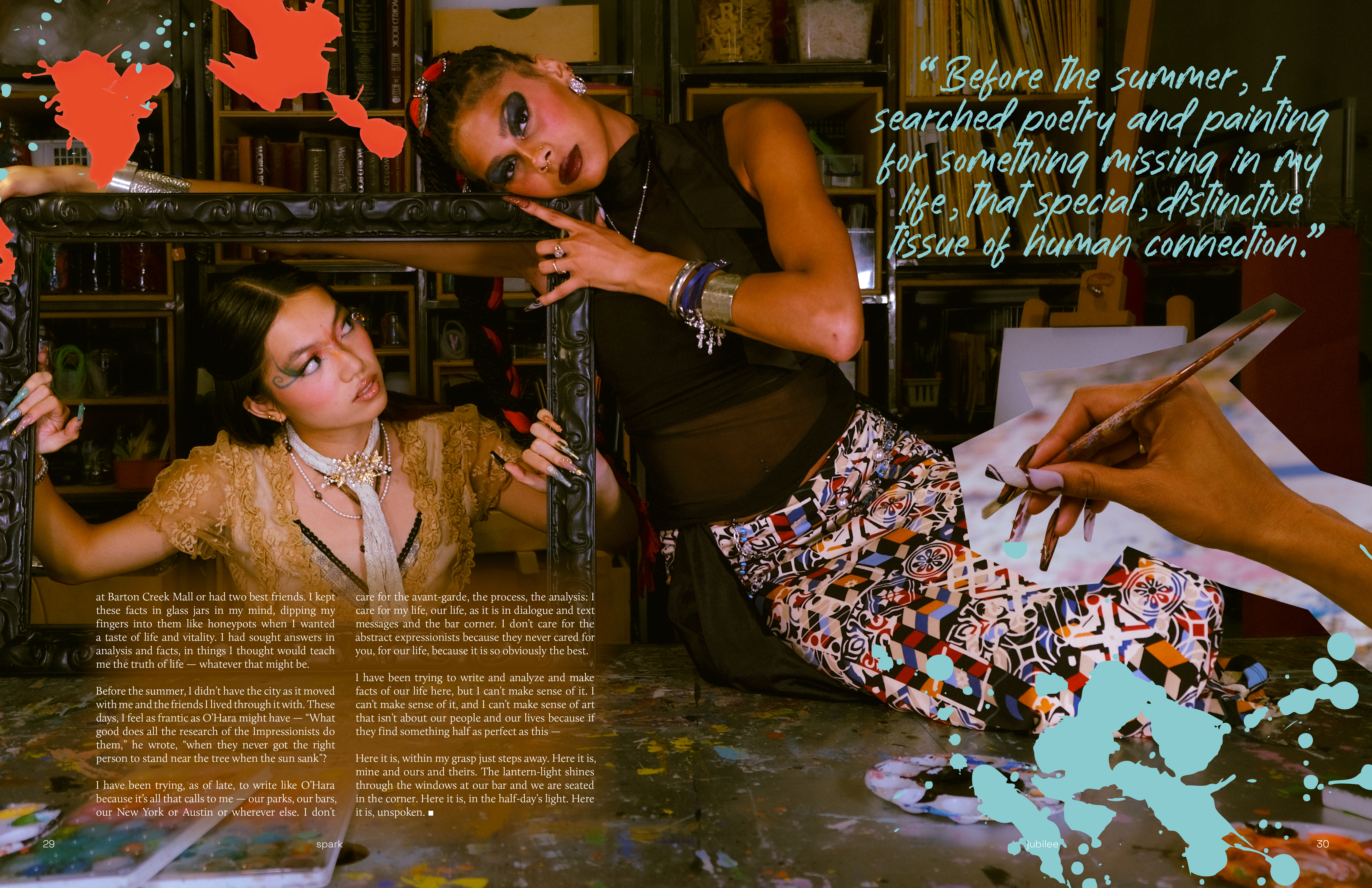
Before the summer, I searched poetry and painting for something missing in my life, that special, distinctive tissue of human connection. I searched in the bathtub, the BookPeople, and the dry spot between my thumb and pointer finger. I was obsessed with the details of other people’s lives: that they watched movies every Tuesday at Barton Creek Mall or had two best friends. I kept these facts in glass jars in my mind, dipping my fingers into them like honeypots when I wanted a taste of life and vitality. I had sought answers in analysis and facts, in things I thought would teach me the truth of life — whatever that might be.
Before the summer, I didn’t have the city as it moved with me and the friends I lived through it with. These days, I feel as frantic as O’Hara might have — “What good does all the research of the Impressionists do them,” he wrote, “when they never got the right person to stand near the tree when the sun sank”?
I have been trying, as of late, to write like O’Hara because it’s all that calls to me — our parks, our bars, our New York or Austin or wherever else. I don’t care for the avant-garde, the process, the analysis: I care for my life, our life, as it is in dialogue and text messages and the bar corner. I don’t care for the abstract expressionists because they never cared for you, for our life, because it is so obviously the best.
I have been trying to write and analyze and make facts of our life here, but I can’t make sense of it. I can’t make sense of it, and I can’t make sense of art that isn’t about our people and our lives because if they find something half as perfect as this.
—
Here it is, within my grasp just steps away. Here it is, mine and ours and theirs. The lantern-light shines through the windows at our bar and we are seated in the corner. Here it is, in the half-day’s light. Here it is, unspoken. ■
Layout: Emmy Chen & Sarah David
Photographer: Tai Cerulli
Videographer: Mo Dada
Stylist: Wen Wang
HMUA: Andromeda Rovillain
Nails: Alyssa Nguyen-Boston
Models: Da’Moni Babineaux & Isabella Leung
Other Stories in Jubilee
© 2025 SPARK. All Rights Reserved.