
The Lemon Tree Out Back
By Laasya Raju
December 5, 2025


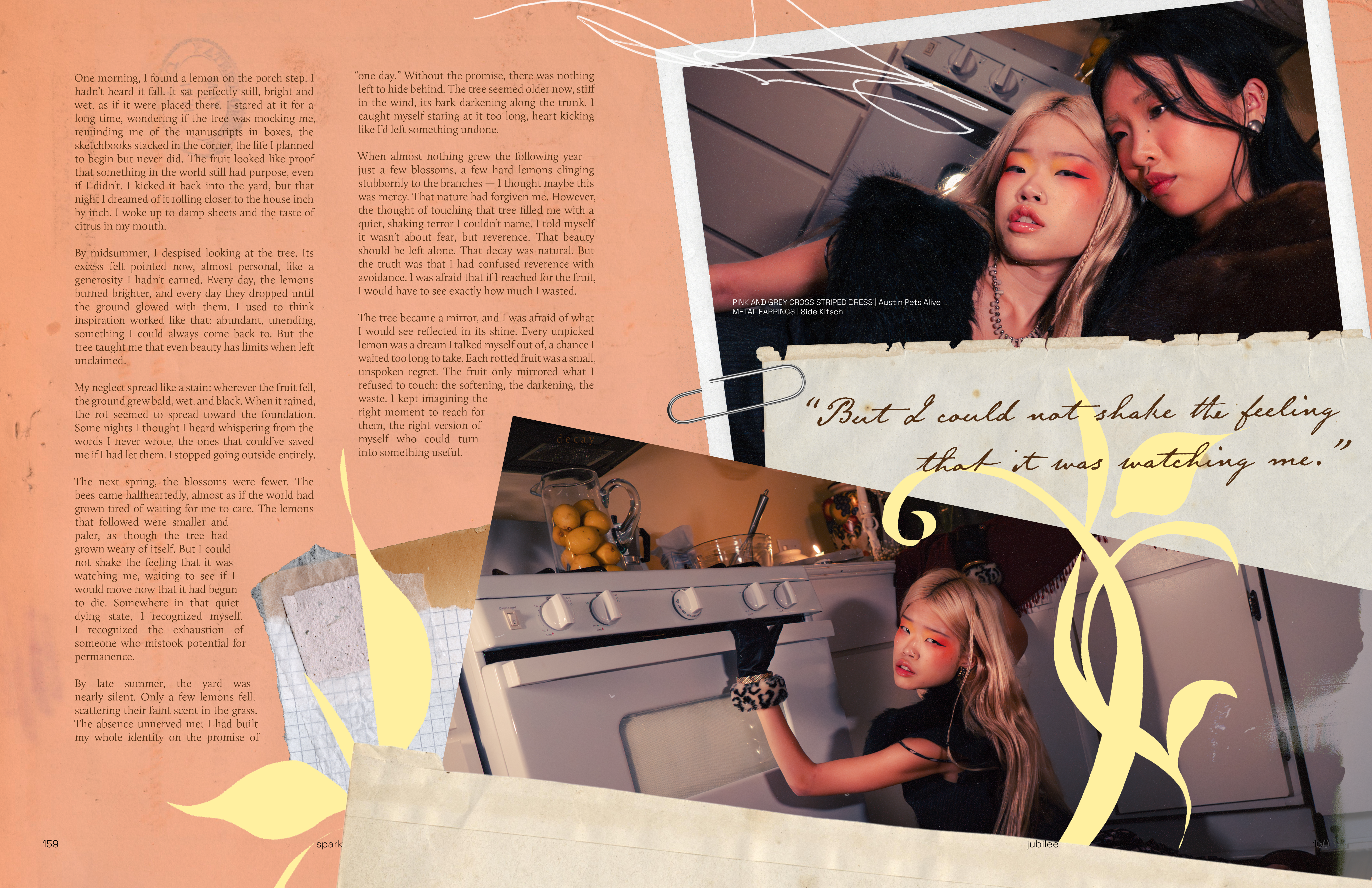

Rot begins not in the fruit, but in the one who watches it fall.
Behind my first house stood a lemon tree no one claimed. I don’t remember when I first noticed it, only that once I did, it began to feel like it had always been there. The trunk leaned slightly toward the house, and I often wondered if it had grown that way, or if it had been reaching for me all along.
The weight of the fruit bent the branches low, so heavy they brushed the ground, and the lemons rotted where they fell — whole seasons melting into the dirt because nobody bothered to pick them. I never did. Every time I thought of touching them, my stomach tightened, as though something deep inside me already knew I would not survive what I found beneath their skins. Instead, I watched the fruit fall, one by one, until the tree stood bare again.
The first spring, the tree bloomed in a way that felt careless, almost arrogant. So many lemons clung to the branches that they dragged low over the grass, hundreds of small suns swelling in the heat. They were too beautiful, too numerous — the yellow hurt to look at. It filled my vision until my eyes watered and the edges of the world went white. I remember thinking that if I reached out my hand, the color might burn me.
I told myself I’d gather the fruit eventually, make something bright and sweet to justify all that abundance, but I didn’t. Every day I meant to start — to open the notebook again, to write something worth reading, to prove I hadn’t wasted what I’d been given. But the weeks kept passing, and I did nothing. Each fallen lemon felt like a page I’d left blank. They dropped through the summer, splitting on impact. The ground beneath the tree grew soft with rot.
It was easier to pretend the tree wasn’t mine, to imagine that if I ignored it long enough, it would stop producing fruit. I told myself that maybe I was waiting for the right time, the right version of myself, the one who could create something whole again. But the truth was simpler and uglier: I was afraid — not of the fruit, but of what it would mean to take it, and what I might have to admit about myself if I did.
By the second summer, the lemons multiplied like a reproach. The branches sagged so low they looked broken, yellow fruit hanging like swollen hearts ready to burst. I began to dream of them splitting open, spraying juice against the grass like blood. I started closing the blinds, but even then I could feel the light pressing through: insistent, patient, unbearable. Every idea I’d ever abandoned, every project half-finished, seemed to hum beneath the floorboards. The world outside was still creating; I was not.
One morning, I found a lemon on the porch step. I hadn’t heard it fall. It sat perfectly still, bright and wet, as if it were placed there. I stared at it for a long time, wondering if the tree was mocking me, reminding me of the manuscripts in boxes, the sketchbooks stacked in the corner, the life I planned to begin but never did. The fruit looked like proof that something in the world still had purpose, even if I didn’t. I kicked it back into the yard, but that night I dreamed of it rolling closer to the house inch by inch. I woke up to damp sheets and the taste of citrus in my mouth.
By midsummer, I despised looking at the tree. Its excess felt pointed now, almost personal, like a generosity I hadn’t earned. Every day, the lemons burned brighter, and every day, they dropped until the ground glowed with them. I used to think inspiration worked like that: abundant, unending, something I could always come back to. But the tree taught me that even beauty has limits when left unclaimed.
My neglect spread like a stain: wherever the fruit fell, the ground grew bald, wet, and black. When it rained, the rot seemed to spread toward the foundation. Some nights I thought I heard whispering, not from beneath the floorboards but from the words I never wrote, the ones that could’ve saved me if I’d let them. I stopped going outside entirely.
The next spring, the blossoms were fewer. The bees came halfheartedly, almost as if the world had grown tired of waiting for me to care. The lemons that followed were smaller and paler, as though the tree had grown weary of itself. But I could not shake the feeling that it was watching me, waiting to see if I would move now that it had begun to die. Somewhere in that quiet dying state, I recognized myself. I recognized the exhaustion of someone who mistook potential for permanence.
By late summer, the yard was nearly silent. Only a few lemons fell, scattering their faint scent in the grass. The absence unnerved me; I had built my whole identity on the promise of “one day.” Without the promise, there was nothing left to hide behind. The tree seemed older now, stiff in the wind, its bark darkening along the trunk. I caught myself staring at it too long, heart kicking like I’d left something undone.
When almost nothing grew the following year — just a few blossoms, a few hard lemons clinging stubbornly to the branches — I thought maybe this was mercy. That nature had forgiven me. However, the thought of touching that tree filled me with a quiet, shaking terror I couldn’t name. I told myself it wasn’t about fear, but reverence. That beauty should be left alone. That decay was natural. But the truth was that I had confused reverence with avoidance. I was afraid that if I reached for the fruit, I would have to see exactly how much I wasted.
The tree became a mirror, and I was afraid of what I would see reflected in its shine. Every unpicked lemon was a dream I talked myself out of, a chance I waited too long to take. Each rotted fruit was a small, unspoken regret. The fruit only mirrored what I refused to touch: the softening, the darkening, the waste. I kept imagining the right moment to reach for them, the right version of myself who could turn decay into something useful. But the moment never came. It was never going to. I had let myself rot in parallel — a harvest of possibility, lost to hesitation.
Some afternoons, I’d stand at the back door, palms pressed to the glass, waiting for fruit that never came. I wanted one more season of excess. I wanted one more season of the branches bowing reverently, yellow skins littering the ground, the sickly sweetness hanging in the air. I wanted one more season of it all back, all of it, so I could finally gather what I’d left to waste. But the tree stayed mostly bare.
By last summer, I couldn’t stand it anymore. I picked one of the few lemons that clung stubbornly to the branches. The skin was mottled and thin under my thumb. It felt lighter than I expected. The branch quivered as I pulled it, as though it hurt. A thin crack echoed up the wood. For a moment, I thought I heard something inside the fruit move. I carried it inside like it was fragile, like it might answer something if I let it.
I sliced it open, the knife slipping easily through the soft rind. The smell rose up sharp and clean, the first real scent of lemon in years. I pressed it to my mouth.
The bitterness hit instantly. It was sour enough to make my teeth ache and my eyes water, filling my whole mouth like a shout. I spit it into the sink, throat burning, and stood there with my hands braced on the counter, the taste clinging like it meant to stay.
Now, when I look at the tree, I understand the real cruelty of it. Not that it grew without me, but that it never needed me at all. The lemons were always going to fall. The ground was always going to take them back.
After all that waiting, after all those seasons, this was what I was afraid of: not sweetness, never sweetness, but this —
the slow, inevitable bitterness of it all.
Rot begins not in the fruit, but in the one who watches it fall. ■
Layout: Melissa Huang
Photographer: Miranda Revilla
Videographer: Madison Ngo
Stylist: Olivia Birge
HMUA: Nguyen Pham & Kennedy Ruhland
Nails: Rayna DeJesus
Models: Elaine Gong & Mia-Katherine Tucker
Other Stories in Jubilee
© 2025 SPARK. All Rights Reserved.