
UNTIL TORNADO GREEN
By Katherine Manz
December 5, 2025


His body is prayer turned flesh. It feels good, doesn’t it?
Half of all sports fans — 50 percent — believe that the divine has a hand in sport. 26 percent have prayed for God to help their team. 21 percent perform rituals.
At two o’clock in the morning on June 20, 1999, a man swaddled in green polyester and tacky sweat holds a 34-pound hunk of metal like a lifeline. His head is thrown back; his eyes are closed. It’s the best day of his life.
On the other side of another town, I am somewhere, something. Maybe watching, maybe not. My 23-year-old father leaves his feet momentarily as light and noise and absolute victory fill the room from the television. This moment has a consequence: nearly eight years later, I am born into a world where miracles do happen.
Growing up, I was taught that there are certain things to be treated with religious devotion. I do my schoolwork. I read books on books. I concede space to my elders. God never captures my attention, so I slump at the altar of hard work like my mama tells me, always saying, It feels good, doesn’t it? It feels good to be exceptional, to trust your hands to make it so. I learn a contiguous world: if you work hard, you will win.
The man is laughing, passing a cigar around. There’s something familiar about his face. His body is prayer turned flesh. It feels good, doesn’t it?
He is an imagined memory, a ghost. Still, at 10, I see him peering around doorways, printed on the back of my father’s jersey. When I begin watching hockey, he is everywhere. Mo, Mikey, Modano. Always straight-faced, lacing his skates, the back of his jersey flapping. This is hockey: be classy, don’t step on any toes. Do your job and go home.
At 16, I started working for magic. I don’t know how to explain the ways victory becomes personal. I pull on my green socks and my mom’s jersey. I walk into the arena on my first playoff night, buzzing with nerves and looking for fingerholds, and shove my phone under my seat because it feels like the right thing to do.
The NHL’s bloated playoff format demands that a Stanley-Cup-winning team play between 16 and 28 playoff games to get there. The 1999 Dallas Stars played 23: two months of getting it all right.
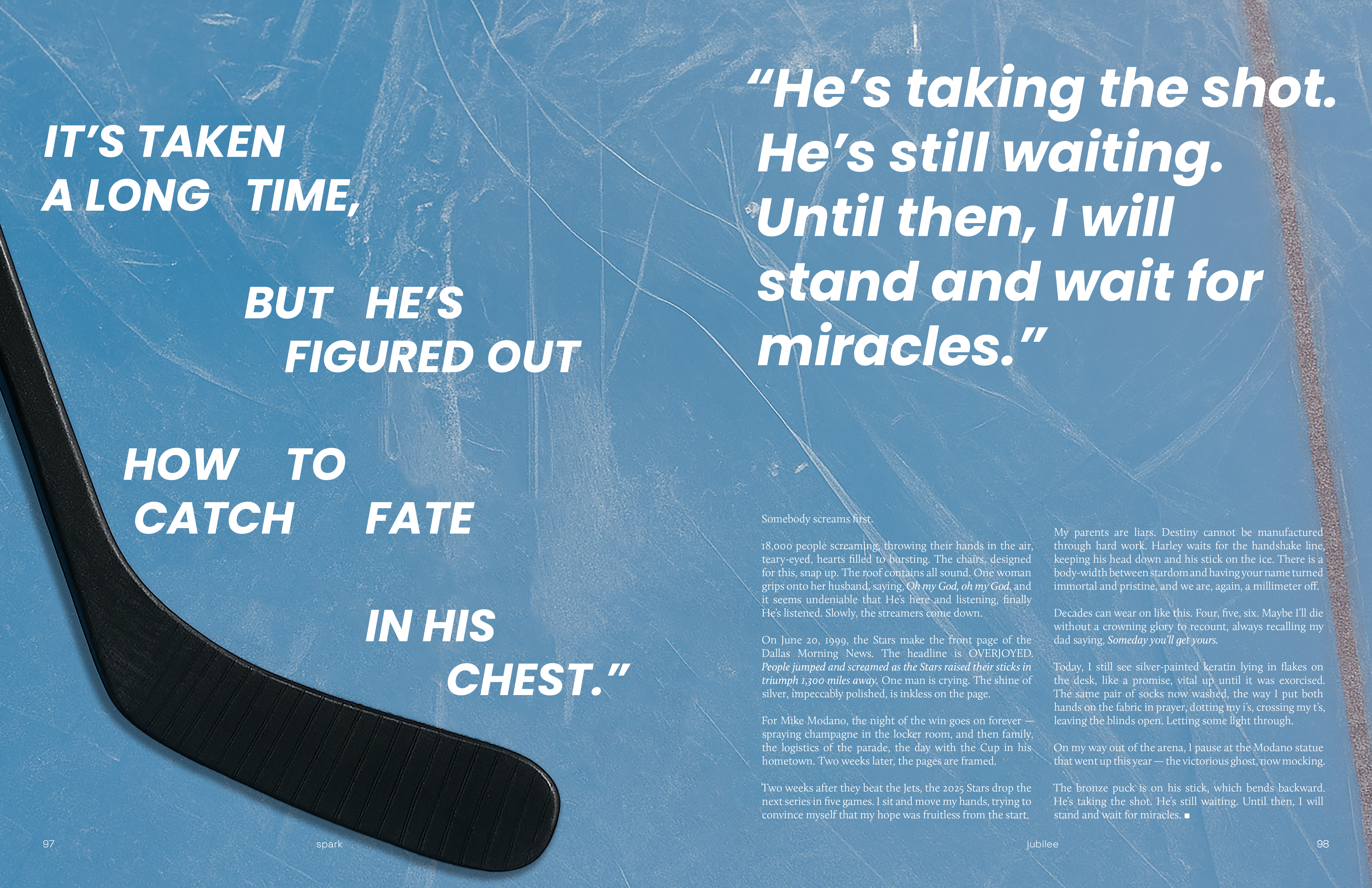
I have no idea what Mike Modano did the morning of June 19, 1999, the day the Stars would play for the Stanley Cup. I imagine something like this: he orients his chair the proper way, eats the appropriate number of eggs for breakfast. Every one of his warm-up shots goes in. He is 29 and will not let God pass him by again — I can feel it, the coarse tape tight on his wrists, the slow-mouthed prayers, the breath replete with invincibility. His first stride on the ice that night leaves a long white trail of stardust. It’s taken a long time, but he’s figured out how to catch fate in his chest.
I watch him go, mouth open. I think: all history is retrospective — he must’ve known then. He must’ve.
In 2024, we’re all still scrambling for something solid. I find it, finally; by the second and third games, every move is premeditated. In a week, hearing Zach Bryan will begin rubbing my ears raw, but for now, it is a steady support, a comfort. I grip my phone in my hand when play starts.
Do you think it matters which way it faces? Breathe. I forgot my bracelets. Breathe, Katie. If I sing under my breath this whole period, we will win. If I sacrifice my breath and do not close my eyes, we will win.
It isn’t for hope that I move my body in my own kind of reverence — pulling on my sweatshirt, my lucky necklace; singing the proper music; growing my fingernails out for months. It’s for fear. It goes like this: IF I do not wash my hair tonight, THEN mine will be the misstep that keeps all of us from the absolute ecstasy of having something to staple our names to.
The Stars win the game. I repeat my song and wear out my socks. The green and silver polish on my nails, a holdover from prom, is beginning to chip. I like my nails short, but I won’t cut them. Some things demand sacrifice.
In the playoffs, games simply continue until one team wins, 20-minute periods set like teetering wooden blocks. Game 6 in 1999, the Cup-winner, was 115 minutes, 13 seconds: three periods and nearly all of three overtimes. Pacing, gripping. Lucky towel twisted in the palm. There are so many more ways to pray than you realize.
What happens if Modano eats a different pre-game meal? Do you care to find out?
I don’t. I follow his example, and my Stars make it miraculously through the first round of the playoffs in seven games — the marquee series of the round. The bus takes me home. Because I have done it right, I am there, in the echoing amphitheater of flashing lights and rally towels, shouting until my head hurts.
Two weeks later: Round 2, Game 6. Overtime. There are only so many outcomes.
“I don’t want to face Hellebuyck and the Jets at home,” says the woman behind me. “Best finish them off here.”
The lights are too much; I close my eyes and try to settle my heart, which screams like a throttled rabbit. When watching overtime at home, I habitually check the score on my phone, which updates maybe fifteen seconds faster than my stream. Here, there is only bare ice stretching out into the endless possibility of the horizon.
At the end, we were all banged up. I’m not sure if we could have won Game 7 with all the injured players. I do look at that and think it might have been a kind of destiny thing.
The green slip of him comes out of nowhere. 90 seconds into overtime, Dallas Stars defenseman Thomas Harley takes a beautiful one-touch slap shot that finds only net.
Somebody screams first.
Eighteen thousand people screaming, throwing their hands in the air, teary-eyed, hearts filled to bursting. The chairs, designed for this, snap up. The roof contains all sound. One woman grips onto her husband, saying, Oh my God, oh my God, and it seems undeniable that He’s here and listening, finally He’s listened. Slowly, the streamers come down.
On June 20, 1999, the Stars make the front page of the Dallas Morning News. The headline is OVERJOYED. People jumped and screamed as the Stars raised their sticks in triumph 1,300 miles away. One man is crying. The shine of silver, impeccably polished, is inkless on the page.
For Mike Modano, the night of the win goes on forever — spraying champagne in the locker room, and then family, the logistics of the parade, the day with the Cup in his hometown. Two weeks later, the pages are framed.
Two weeks after they beat the Jets, the 2025 Stars drop the next series in five games. I sit and move my hands, trying to convince myself that my hope was fruitless from the start.
My parents are liars. Destiny cannot be manufactured through hard work. Harley waits for the handshake line, keeping his head down and his stick on the ice. There is a body-width between stardom and having your name turned immortal and pristine, and we are, again, a millimeter off.
Decades can wear on like this. Four, five, six. Maybe I’ll die without a crowning glory to recount, always recalling my dad saying, Someday you’ll get yours.
Today, I still see silver-painted keratin lying in flakes on the desk, like a promise, vital up until it was exorcised. The same pair of socks now washed, the way I put both hands on the fabric in prayer, dotting my i’s, crossing my t’s, leaving the blinds open. Letting some light through.
On my way out of the arena, I pause at the Modano statue that went up this year — the victorious ghost, now mocking.
The bronze puck is on his stick, which bends backward. He’s taking the shot. He’s still waiting. Until then, I will stand and wait for miracles. ■
Layout: Andy Kang
Other Stories in Jubilee
© 2025 SPARK. All Rights Reserved.