/path/to/restart-script.sh
By Belle Xu
December 5, 2025



The only way out is to find the weak point in the code and hack reality itself.
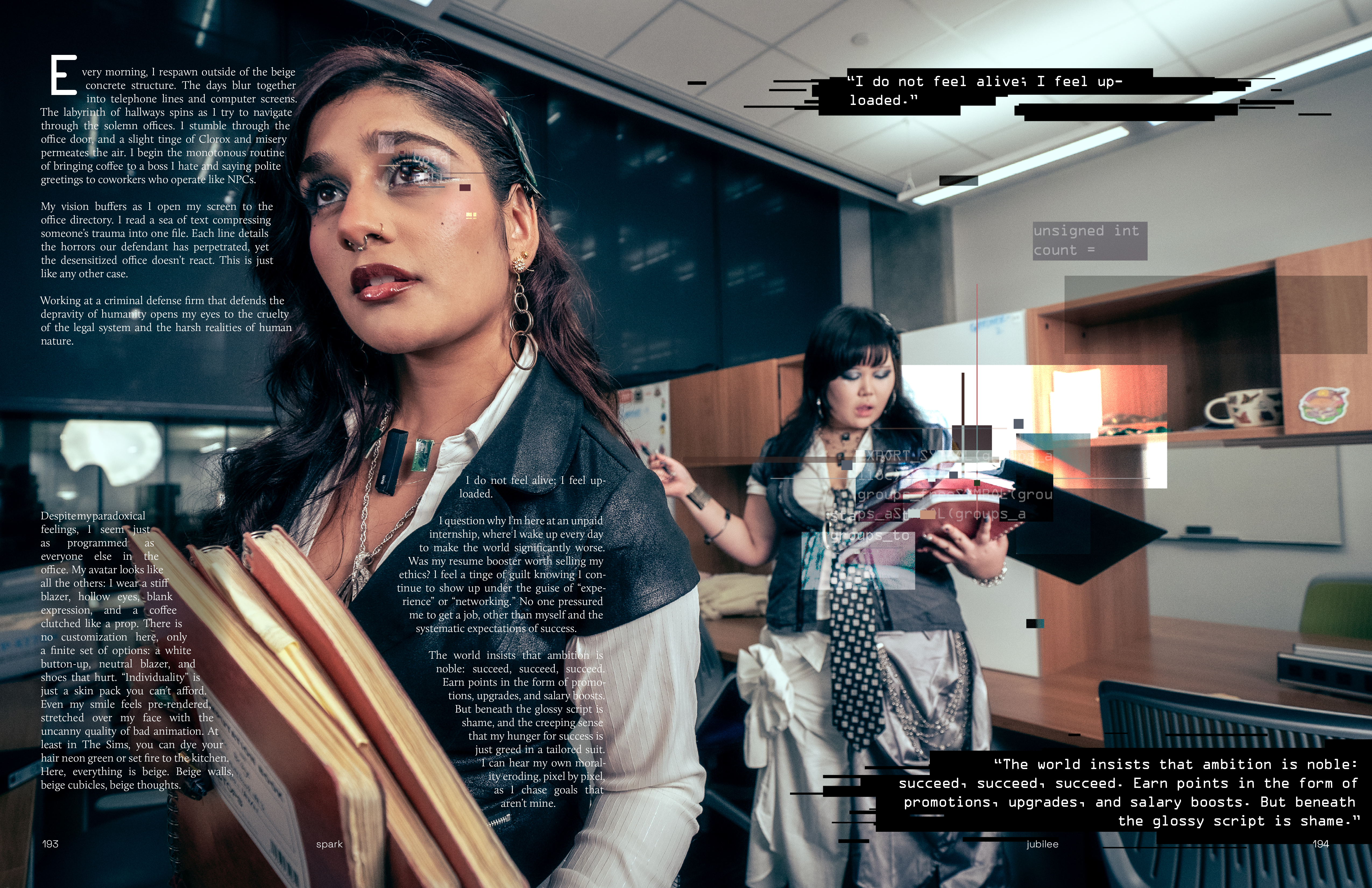
Every morning, I respawn outside of the beige concrete structure. The days blur together into telephone lines and computer screens. The labyrinth of hallways spins as I try to navigate through the solemn offices. I stumble through the office door, and a slight tinge of Clorox and misery permeates the air. I begin the monotonous routine of bringing coffee for a boss I hate and saying polite greetings to coworkers who operate like NPCs.
My vision buffers as I open my screen to the office directory. I read a sea of text compressing someone’s trauma into one file. Each line details the horrors our defendant has perpetrated, yet the desensitized office doesn’t react. This is just like any other case.
Working at a criminal defense firm that defends the depravity of humanity opens my eyes to the cruelty of the legal system and the harsh realities of human nature.
Despite my paradoxical feelings, I seem just as programmed as everyone else in the office. My avatar looks like all the others: I wear a stiff blazer, hollow eyes, blank expression, and a coffee clutched like a prop. There is no customization here, only a finite set of options: a white button-up, neutral blazer, and shoes that hurt. “Individuality” is just a skin pack you can’t afford. Even my smile feels pre-rendered, stretched over my face with the uncanny quality of bad animation. At least in The Sims, you can dye your hair neon green or set fire to the kitchen. Here, everything is beige. Beige walls, beige cubicles, beige thoughts.
I do not feel alive; I feel uploaded.
I question why I’m here at an unpaid internship, where I wake up every day to make the world significantly worse. Was my resume booster worth selling my ethics? I feel a tinge of guilt knowing I continue to show up under the guise of “experience” or “networking.” No one pressured me to get a job, other than myself and the systematic expectations of success.
The world insists that ambition is noble: succeed, succeed, succeed. Earn points in the form of promotions, upgrades, and salary boosts. But beneath the glossy script is shame, and the creeping sense that my hunger for success is just greed in a tailored suit. I can hear my own morality eroding, pixel by pixel, as I chase goals that aren’t mine.
The illusion of choice is the cruelest part. Every option feels autonomous — choosing your major, your company, your career path — but in reality, they all lead to the same mega-conglomerates. The system rewards conformity disguised as independence and convinces us that compliance is empowerment. The developer of my program tells me what I will do before I do it: User#7 checked her inbox. User#7 updated the spreadsheet. User#7 attended the 10 a.m. meeting and laughed at her boss’s joke.
Did I even want this? Did I truly choose this? Or was I tricked by TV shows with fast cuts of glass skyscrapers and the dreams my parents alluded to at bedtime? Was sitting in a sharp suit and clicking on my laptop worth the promise of success? I try to click options that don’t exist. The cursor flickers but won’t move.
Soon, the office itself begins to warp. The monitor freezes, then fills in responses without my hands moving. Happy to help! Excited to be part of the team! My keyboard clacks on its own.
The screen cracks at the edges like a spiderweb fracture, leaking static into the room. I try to type my own words, but they appear pre-written, auto-filled with enthusiasm I don’t feel. The more I resist, the less control I have. I am not piloting the avatar anymore; the game is piloting me.
The carpet feels damp under my shoes. The hallways are narrower than I remember. Fluorescent lights hum louder. The walls inch closer, cubicles multiplying like fractals. NPC coworkers pass me in endless loops, their polite greetings stuck on repeat: Crazy weather today. Almost Friday. Crazy weather today. Their mouths move, but their eyes are glazed, blank, like corrupted souls without a body.
I sit at my desk, staring at a case file that details how we can keep a sex offender out of jail. My hands move, but my mind drifts. I don’t care about the number of LinkedIn connections or the bullet points on my resume. I care about looking beyond the avatar of my coworkers and seeing a life with goals and dreams beyond this corporation. I want to find the connection that holds us all together and makes us human — emotion and creation beyond the program.
The ideals of success begin to rot in front of me. Is the passion for work real, or just a slogan stitched on corporate posters in the break room? Every ambition tastes metallic, counterfeit. If all originality is prepackaged, then the only rebellion is to make something unprogrammable: love that can’t be monetized, laughter too messy to be optimized, grief too raw to be turned into content. To feel everything — to feel fully — is how we break the script.
But the final boss is not my manager with shark-like grins and eyes filled with bloodlust, or the desk receptionist with her weaponized cheer. It’s not even the CEO whose photo glares down at me from framed posters. The enemy is faceless: it’s the system itself. The code that binds the game together, the invisible architecture that respawns me endlessly. It is colder than flesh, less merciful than malice. You cannot argue with it; you cannot inspire empathy in lines of code.
The corporation has no body. It cannot look me in the eye or hear me plead. It is indifferent, inhuman, and endless. A spreadsheet with teeth. A cubicle wall that breathes. Its objective is simple: keep me here forever. Keep me clicking, replying, nodding, and logging in.
So I look where the coders never wanted me to look: behind the vending machine, down the emergency stairwell that ends in a locked door, and in the broom closet where the walls tremble as if they’re hiding a pulse. Inside the smiles, laughter, and shared eye-rolls between me and my coworker, who also despises this job, I see individuality. These places feel unscripted, unrendered, and dangerous.
The only way out is to find the weak point in the code and hack reality itself. I imagine restarting the script — not to replay the loop, but to break it. I’m rebooting in a world where sincerity is not a glitch but a feature, fluorescent static is replaced with daylight, and my avatar is not beige but human. The game may never end, but if I recognize the humanity and morality beyond corporate systems, I can play outside its rules.
I open my eyes, and the hallways keep shifting, narrower still. But this time, I don’t move like the code scripted me to. I wait. I listen for silence under the hum. I imagine love, laughter, fear; all the things the game cannot simulate. For the first time, the cursor flickers, uncertain. The code hesitates. ■
Layout: Nick Reyna
Photographer: Joseph Chunga Pizzaro
Videographer: Tyler La Salle
Stylists: Zoe Costanza & Hailey Chuong
HMUA: Jalynn Shrepee
Nails: Grace Joh
Models: Vani Shah & Grace Joh
Other Stories in Jubilee
© 2025 SPARK. All Rights Reserved.